

Why the Future Belongs to Those Who Create Meaning, Not Just Output
For most of modern history, we organized work around a deceptively simple idea: define the job, hire the person, measure the output. It was a logical response to the economies that shaped us – industrial, then knowledge-based – where efficiency, specialization, and repeatability were the engines of value creation. The system had a certain clarity to it. You knew your role. You knew what success looked like. You knew the path forward.
Artificial Intelligence is now dismantling that clarity, by forcing a question that most organizations have been surprisingly reluctant to ask openly: what is the contribution that only a human can make? It sounds almost philosophical, yet it is one of the most practically important strategic questions of our current time.
The End of Work as We Know It
It is natural, when confronted with a disruption of this scale, to focus on jobs. Which ones will survive? Which professions are most exposed? Where is the risk greatest? These are understandable questions, but they may not be the most useful ones. Because jobs, when you step back, are temporary constructs. They are the containers we created to organize contribution at a particular moment in time, with the technology and economic conditions that existed then. When those conditions change – and they always eventually do – the containers get redesigned, as they always have.
What endures is not the job. It is the contribution. The people who have navigated previous waves of disruption most successfully were rarely those who held on most tightly to their existing roles. They were those whose value was never truly located in a task list to begin with. Their value lived in their ability to create clarity where there was confusion, to build trust where there was resistance, to connect ideas that others had not yet seen as connected, and to move people toward outcomes that mattered. Those capabilities are not on any job description. And they are remarkably difficult to automate.
From Performing Tasks to Shaping Outcomes
There is a shift underway in where professional value actually lives, and it is worth having an honest clear look at. For a long time, expertise and precise execution were the foundations of professional success. If you knew more than others, and could do more than others, you created value. That was a reasonable equation when knowledge was scarce and skilled execution was hard to scale.
That equation is changing. Execution is becoming abundant. AI can write, analyze, synthesize, code, and automate at a speed and scale that would have seemed implausible a decade ago. The scarcity is shifting – away from task performance and toward something harder to define and considerably harder to replicate.
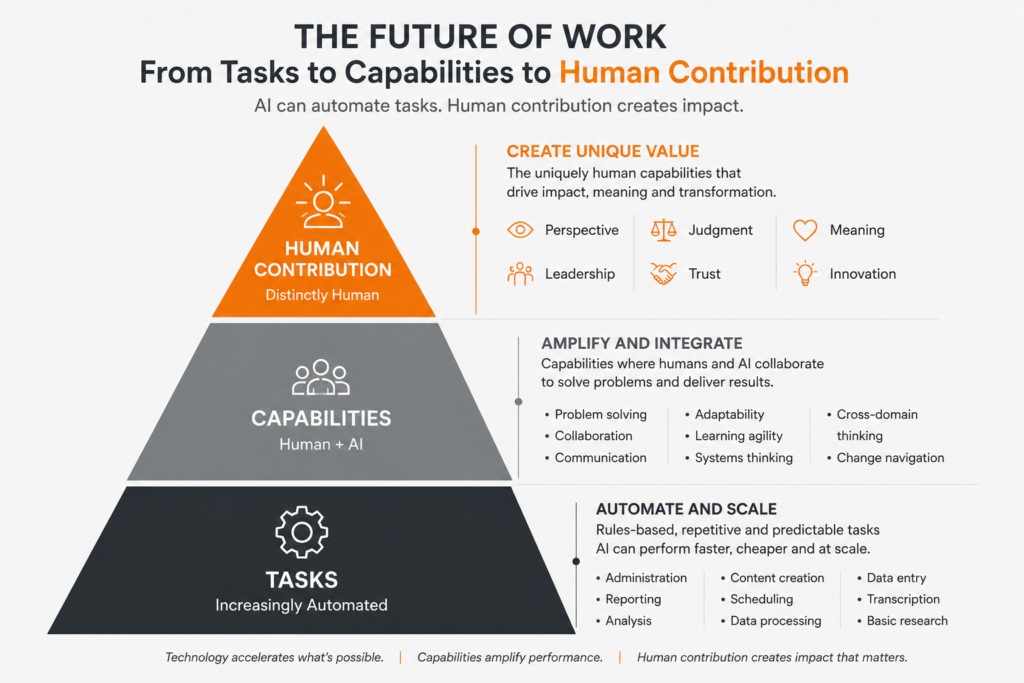
The future belongs less to those who perform tasks and more to those who shape the outcomes those tasks are meant to serve. To those who can ask better questions before rushing toward answers. Who can define what a meaningful goal actually looks like in a specific human context. Who can navigate genuine ambiguity – not the manufactured kind that dissolves with more information, but the kind that requires judgment and courage. Who can create alignment across people who see the world differently, and who can turn insight into momentum.
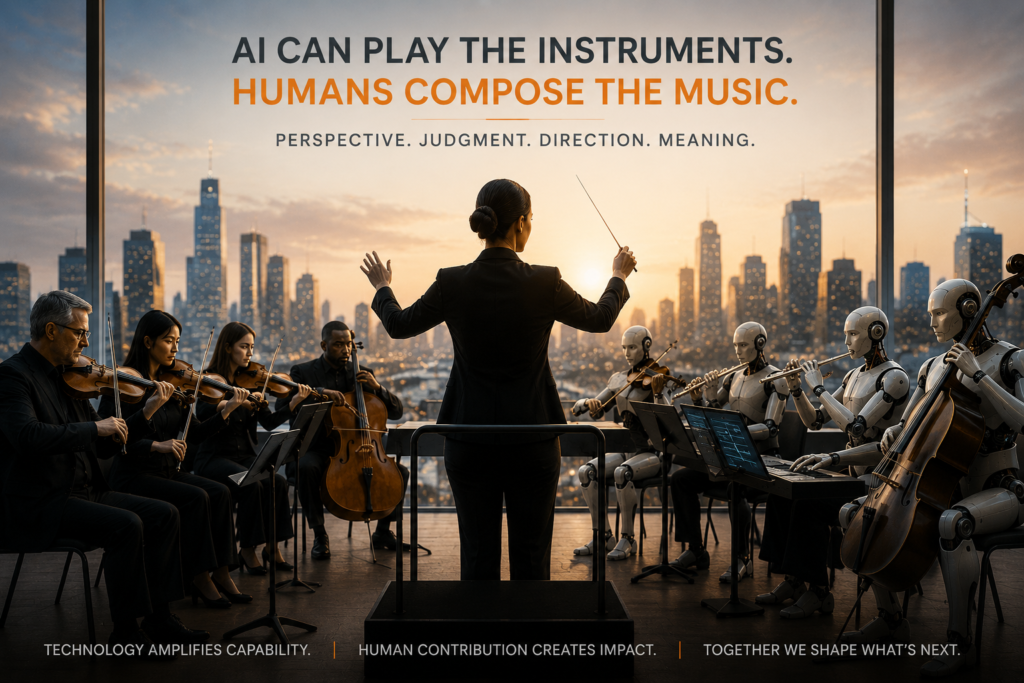
The shift, in other words, is from operator to orchestrator. That distinction deserves more attention than it typically receives.
The New Human Advantage
Much of the public conversation about AI concentrates on what machines are becoming capable of. That is worth understanding. But perhaps the more illuminating question – particularly for those thinking about the long arc of their careers and organizations – is what humans contribute most distinctively when machines handle much of the execution.
The answer, I think, lives across five domains.
1. Perspective
AI provides answers. Humans decide which questions matter. The ability to stand inside a complex situation and see it from multiple angles simultaneously – to challenge the assumptions baked into how a problem has been framed, to notice what is being overlooked, to find the opportunity hidden inside the constraint – remains one of the most valuable things a human mind can do. Better technology does not guarantee better outcomes. Better thinking does.
2. Judgment
We live in a world of extraordinary information abundance and genuine wisdom scarcity. Judgment is not the ability to process information quickly, but the ability to interpret information within its human context – to weigh competing priorities, to assess not just what is probable but what is right, to make sound decisions in the presence of irreducible uncertainty. It is built slowly, through experience, reflection, and the kind of understanding that cannot be downloaded.
3. Connection
Organizational transformation almost never fails because of a technology problem. It fails because people are not truly aligned – because trust has not been established, because competing interests have not been genuinely reconciled, because the human dimension of change has been underestimated.
As AI takes on more of the analytical and executional work, the ability to build real trust, to influence without authority, to hold space for people navigating uncertainty – these are not just so called soft skills, but core strategic capabilities.
4. Meaning
Machines can optimize, but they cannot make anyone care. People need to understand why their work matters. They need a sense of purpose that connects their daily effort to something larger than the task itself. The leaders and professionals who can help others locate meaning in what they do – who can articulate a direction that people genuinely want to move toward – will create the kind of engagement and commitment that no algorithm will ever generate.
5. Adaptability
The most valuable professionals of the coming decade will not be those who know the most. They will be those who learn the fastest – who can let go of what no longer serves them, absorb what is newly relevant, and reconstruct their contribution in response to conditions that keep changing. The willingness to continuously evolve may be the single most important capability of the AI era.
A Different Perspective on Careers
When disruption arrives – and it tends to arrive faster than we expect and more thoroughly than we prepare for – the instinctive question is: am I still needed? It is a very human question. But it may not be the most generative one. The better question is: what is my human contribution?
There is a meaningful difference between thinking of your work as a job and thinking of it as a career. A job is a role you occupy at a particular moment. A career is something richer – the ongoing accumulation of capabilities, experiences, relationships, and perspectives that compound over time and travel with you across every context you move through.
Seen through that lens, disruption changes character. Redundancy becomes a chapter, not an ending. Technological upheaval becomes an invitation to evolve rather than a verdict on your value. Career growth becomes less about ascending a defined ladder and more about continuously expanding the scope of your contribution.
The judgment you have developed, the relationships you have built, the hard-won perspective you carry – none of that is restructured away. It belongs to you. And in a world increasingly shaped by AI, it may be worth more than it has ever been.
The Rise of the Human-AI Professional
Not long ago, the concept of the “hybrid professional” referred to someone who bridged two disciplines – the engineer who understood business, the marketer who could read data, the designer who could think in systems. That combination was genuinely valuable and still is.
But hybrid now means something different. Something more fundamental. The professionals who will create the most value in the coming years are those who can bring human intelligence and artificial intelligence into genuine collaboration. Who understand technology well enough to direct it, and understand people well enough to translate its outputs into decisions, actions, and outcomes that matter.
They are not just users of AI. They are the ones who make AI useful – who close the gap between what the technology can generate and what organizations and people actually need. They are the bridge between analytical capability and human consequence.
Every professional role is quietly becoming this kind of hybrid role. The question is no longer whether AI will be part of how you work. It is whether you are deliberately developing the human capabilities that allow you to create value alongside it – rather than simply hoping that proximity to the technology is enough.
The Leadership Question of Our Time
All of this creates what I believe is the defining leadership challenge of the next decade. And it is not the one that dominates most boardroom conversations.
The question is not how to implement AI. Implementation is a project. It has a beginning, a budget, and a delivery date. The deeper question is: what forms of human contribution create the greatest value in a world where AI handles more and more of the execution?
Organizations that answer that question seriously will find themselves redesigning work in ways that go well beyond technology deployment. They will stop managing collections of job descriptions and start building genuine human capability. They will measure contribution differently – less by activity, more by impact. They will recognize, perhaps for the first time clearly, that technology is not the destination. Human potential is.
Final Reflection
It is worth pausing, amid the noise of this particular moment in history, to notice what this conversation is really about. The future of work is not ultimately a technology conversation. It is a human one. AI is not diminishing human value. It is, in a sense, clarifying it, stripping away the parts of work that were never truly human to begin with, and leaving behind the contribution that only a person, with a particular history and perspective and set of relationships, can make.
Perhaps the most important shift is deceptively simple: From having a role, to creating impact. From performing work, to shaping outcomes. From asking “what do I do?” to asking “what contribution am I here to make?”
In the end, the people who thrive – the ones who look back on this period with a sense of genuine growth – will not be those who competed most effectively with machines. They will be those who became more fully, more creatively, and more intentionally themselves.