

Dear Manager, Your role is becoming more essential than ever!
The AI conversation often focuses on technology, but a big transformation is also happening in your role of the manager.
For years, organizations have talked about moving managers away from control and towards coaching, or even la. AI accelerates that shift, but also adds something new, something more demanding, and something deeply human:
Managers are becoming the critical bridge between technology and human contribution.
Changed responsibilities of the Manager
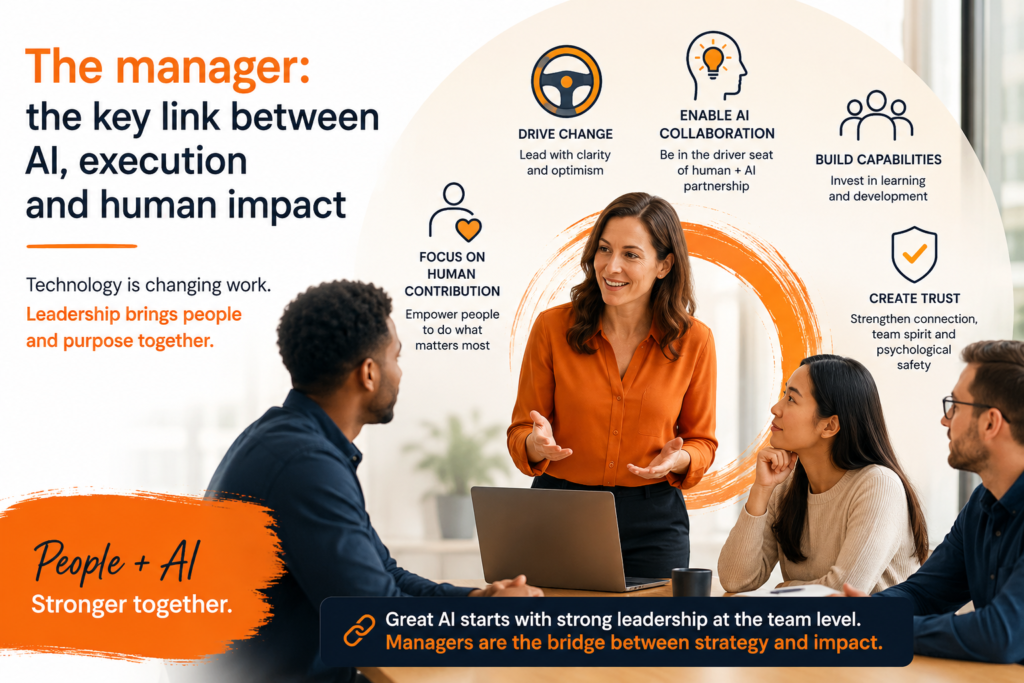
Changed responsibilities of the Manager
As organizations invest heavily in AI, new tools and automation, someone still needs to help teams answer the most important questions:
- What work should humans focus on?
- How do we combine human strengths with AI capabilities?
- What capabilities do we need to develop next?
- How do we keep people engaged during constant change?
- How do we maintain trust, connection and team spirit?
AI may optimize workflows, but it does not create psychological safety, nor builds confidence. It doesn’t help someone navigate uncertainty and it doesn’t inspire a team around a shared purpose. That remains deeply human work.
The narrative that the manager of the future is “just a coach” is only half the story. What is replacing the ‘controlling’ manager is rather complex and consequential. The manager of the AI era is a coach, a capability builder, a change leader, a learning catalyst, an orchestrator of human + AI collaboration, and perhaps most importantly: a creator of trust.
When a company truly invests in AI, someone has to translate that into daily practice. Someone has to say: here’s how we use this, here’s what it means for your work, here’s what responsibility you can take.
Someone has to hold the space for learning when things are uncertain, and for honest conversation when change feels threatening. Someone has to help their team understand where their human contribution remains irreplaceable – the curiosity, the ethics, the relationships, the creative leaps that no model can replicate.
That someone is the manager.
Every AI strategy eventually lands in a team. And every team looks to its manager to determine whether change feels threatening or exciting, whether learning feels optional or essential and whether technology becomes something people resist – or embrace.
Executive leaders can define the vision.
Technology teams can implement the tools.
But managers remain the key link between strategy and execution, between ambition and reality, between the speed AI enables and the trust teams actually need to move with confidence.
In many ways, the success of AI adoption will not be determined by the quality of the technology, but by the quality of leadership closest to the work.
So if you’re shaping your AI strategy right now, think equally hard about your managers. Are they equipped not just to implement, but to inspire? Not just to execute, but to hold culture together through transformation?
Your future may be AI-powered, but it will still be human-led.
Changed responsibilities of the Manager, Your role is becoming more essential than ever!
Read more about Leadership in times of AI