

Why the next era of leadership is not about controlling work, but designing human contribution
There is a shift happening inside organizations, not another digital transformation initiative, nor another AI pilot, but a deeper shift that changes how we think about people, leadership, performance, and even the meaning and future of work itself.
Because while AI is accelerating at extraordinary speed, most organizations are still designed for a world that no longer exists. We continue to organize work around static roles, fixed responsibilities, rigid structures, and assumptions of predictability, while the reality of work has become fluid, interconnected, and continuously evolving.
The tension is beginning to show everywhere. Leaders feel it in overwhelmed teams, employees feel it in blurred expectations and endless priorities, organizations feel it in disengagement, capability gaps, slow adaptation, and cultures struggling to keep pace with change. AI did not create this problem, it simply exposed it.
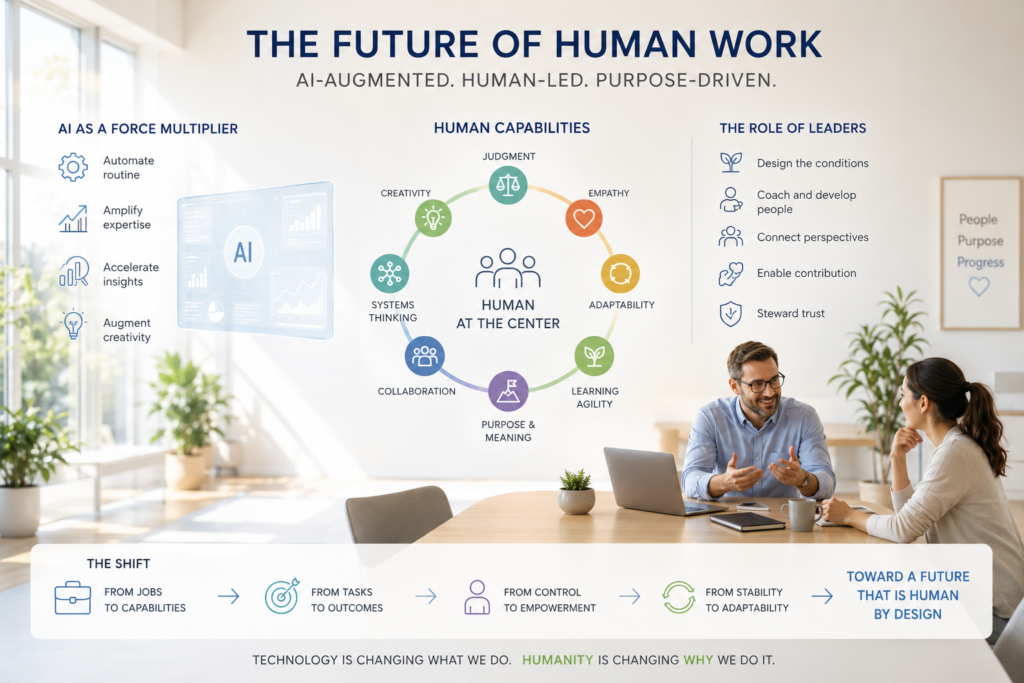
As explored in the whitepaper Rethinking Workforce and Work Design: From Jobs to Capabilities in an AI-Augmented World, the real challenge is not primarily a technology challenge, but a work design and leadership challenge. And that changes everything.
AI Is Changing Work Faster Than Organizations Are Changing Themselves
For years, organizations optimized around efficiency; clear roles., clear reporting lines, defined responsibilities, predictable workflows. That model worked reasonably well in environments where change was slower than organizational redesign. But AI changes the rhythm entirely; tasks disappear, decisions accelerate, boundaries blur, information becomes abundant. Judgment becomes more valuable than routine execution.
The irony is striking: the more technology advances, the more distinctly human capabilities become the differentiator. Because humans provide what AI fundamentally cannot, such as judgment, contextual understanding, ethical reasoning, empathy, meaning-making and human connection.
The future will not belong to organizations that simply deploy the most AI, but it will belong to organizations that redesign work and leadership around human contribution.
Ethan Mollick offers a balanced and insightful perspective on how AI is reshaping work, and how humans contribute.
future of leadership
The End of Leadership as Control
For decades, leadership was largely built around coordination and control. Managers allocated work, monitored performance., managed capacity, reduced risk,ensured consistency. But in AI-augmented organizations, much of the traditional coordination layer becomes automated, accelerated, or distributed.
This fundamentally changes the role of leaders. The future leader is no longer primarily a controller of work. The future leader becomes: an orchestrator of capability, a designer of conditions, a connector of perspectives, a coach of human growth, and a steward of cohesion in complexity.
Leadership is shifting: from supervision to enablement, from authority to influence, from directing tasks to unlocking contribution, from managing roles to developing human capability. And many organizations are not prepared for this shift yet.
Simon Sinek captures trust as leadership shift powerfully in his well-known TED talk on why great leaders create environments where people feel psychologically safe, trusted, and able to contribute fully.
future of leadership
Managers Become Coaches – But Coaching Alone Is Not Enough
Much has already been written about managers becoming coaches. And rightly so. People increasingly need leaders who help them navigate ambiguity, grow continuously, develop self-awareness, strengthen judgment, and connect their work to meaningful outcomes.
The coaching conversation often remains too individualistic. People do not develop in isolation, they develop through contribution. The strongest learning environments are not separate from work, they are embedded inside work. This means the future leader must learn how to:
- create stretch through real contribution,
- make capability development visible,
- facilitate reflection during execution,
- and intentionally design learning into everyday work.
The leader of the future is not merely someone who gives feedback, but someone who creates environments where people expand themselves through meaningful contribution.
From Roles to Capabilities
One of the biggest shifts organizations will need to make is moving away from thinking primarily in roles and jobs – toward thinking in capabilities. Because roles are becoming increasingly unstable. Capabilities are not. A role describes a position in a structure. A capability describes a reliable pattern of contribution across changing contexts. That distinction matters enormously.
In a world where AI constantly reshapes tasks and workflows, organizations can no longer redesign entire role structures every year. Instead, they need stable capability foundations that allow work to evolve dynamically without destabilizing people. Capability-based organizations focus less on: “Which role does this person have?” And more on: “How does this person consistently create value?” This changes the conversation from static job matching to dynamic contribution.
This also changes development. The most forward-thinking organizations are beginning to make human capability visible beyond the CV through capability scans, contribution patterns, learning agility, and leadership potential. At LeadAble, this philosophy is translated into the LeadAble Capability Scan and Assessment – helping organizations identify not only what people have done in the past, but how they create value across changing contexts, collaborate, adapt, learn, and contribute in AI-augmented environments.
Because organizations that cannot see their capabilities cannot orchestrate them. And organizations that cannot orchestrate capability will struggle to adapt.
The Most Valuable Capabilities Will Become Increasingly Human
There is a paradox at the heart of the AI revolution that most people miss: the more intelligent our machines become, the more valuable our humanity gets – with the capacity to navigate the fundamentally human dimensions of organizations and decisions.
Systems thinking matters more now because AI can optimize components brilliantly while missing the whole. Someone has to see the system. Strategic judgment matters because data can illuminate options but cannot choose between values. Someone has to decide what actually matters. Contextual influence matters because organizations do not move on logic alone, they move on trust, identity, and meaning. Someone has to understand that.
The same logic runs through every capability that will define leadership in the years ahead. Learning agility -not the accumulation of knowledge, but the willingness to unlearn and reorient- becomes a survival trait in environments where the half-life of expertise is shrinking. Ethical reasoning becomes load-bearing infrastructure, not a compliance exercise, when AI systems can act at speed and scale with consequences that outpace human oversight. Collaboration across boundaries becomes a differentiator when the hardest problems are precisely those that no single discipline can solve alone.
And then there are the capabilities that operate at the level of human connection itself: emotional intelligence, narrative framing, adaptability, resilience. These have long been undervalued because they are hard to measure, and organizations tend to manage what they can measure. But they are the substrate on which everything else runs. Culture, morale, trust, cohesion – none of it holds without them.
Calling these “soft skills” was always a category error. They are not soft. They are the hardest skills to develop, the hardest to scale, and increasingly, the hardest to replace. In a world drowning in information but starving for meaning, they are the scarcest resource in any room.
Perspective Is a Leadership Capability
Underneath all of these capabilities lies something more fundamental: how a leader sees. Perspective has always shaped leadership but in the age of AI, it becomes a strategic differentiator. The way a leader views people determines more than culture. It determines architecture. Leaders who see people primarily as resources build organizations that optimize for efficiency. Leaders who see people as capable contributors with evolving potential build organizations that optimize for growth, learning, and contribution. Same technology – entirely different outcomes.
Perspective shapes how leaders frame uncertainty – as threat or as signal. How they interpret technology – as a replacement for people or as an amplifier of them. How they communicate change, define performance, and build trust. In times of rapid transformation, leaders are not just managing operations., they are shaping how people collectively make sense of the world around them. That is profound work, and irreducibly human. – You can read more in the book: powers of perspective
For the future of leadership the leaders who will matter most are those who can create clarity where there is genuine complexity, by making it navigable. Align people around meaning, not just around targets. Integrate perspectives that would otherwise fragment into silos or conflict. And sustain trust during uncertainty – which is perhaps the rarest capability of all, because uncertainty is precisely when trust is most tested and most needed.
The Organizations That Thrive Will Be Intentionally Designed
The future of leadership is not about becoming more reactive to change. It is about becoming more intentional in the face of it.
Intentional about how work is designed, how technology is integrated, how people develop, how contribution is recognized. And how human cohesion is protected while everything else accelerates.
AI will keep evolving, but organizations will continue to run on trust, meaning, judgment, and human connection. Those things do not automate. The question, then, is not whether AI will transform organizations. It already is. The real question is whether leaders will consciously redesign their organizations around human capability, or continue forcing people into structures built for a world that no longer exists.
The future of leadership may ultimately come down to this: not controlling people, not optimizing systems, not managing tasks – but creating the conditions in which human capability can continuously evolve, contribute, and thrive alongside technology.
That is the deeper opportunity concealed inside this moment of disruption. Not the replacement of humans by machines, but the rediscovery of what makes human contribution irreplaceable in the first place.
future of leadership
Read more about how to redesign work for organizational effectiveness